
Market linking of petrol and diesel prices has helped the industry.
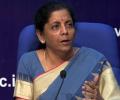
Finance Minister Nirmala Sitharaman on Friday announced a slew of measures to boost economic growth and address distress in various sectors
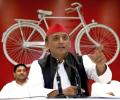
He alleged that the BJP government has lined up a series of programmes to herald the start of the corridor only to deflect people's attention from the PM's 'failure' to double the income of farmers.

The Centre will outline several initiatives in the coming budget, which would enable Bangalore and other metropolitan cities in the country to draw additional resources for infrastructure development, Prime Minister Manmohan Singh said on Friday.

The move came after Prime Minister Narendra Modi told chief ministers of the seven worst affected states on Wednesday that his government has increased the states' limit to spend the SDRF to boost infrastructure to fight the pandemic.

Raising slogans, members of the BRS, Left parties and some members of the Congress walked out of Lok Sabha in protest as the prime minister was speaking.

Prime Minister Vladimir Putin's impassioned support has made Russia a favourite to host a the 2018 World Cup. However, questions abound over the availability of infrastructure to host the event.

The delivery of the Tejas Light Combat Aircraft (LCA) to the Indian Air Force under a Rs 48,000-crore deal will begin from March 2024 and around 16 aircraft will be rolled out annually till the completion of the total supply of 83 jets, Chairman and Managing Director of Hindustan Aeronautics Limited R Madhavan said on Sunday.
Critical of India's "poor" ranking in terms of investment climate, World Bank on Monday said the economy could grow by 2 per cent if it improves infrastructure, business regulations, labour and land laws.

Market participants are hoping for a few tweaks on the taxation front which will encourage consumers and businesses to spend.

A second wave of Covid driven by the Delta variant engulfed the country in May-June bringing the health system to its knees and leaving people gasping for help.

The industry status will help the sector access bank lending at average interest rates

About 60 per cent of India's population depends on agriculture, but its contribution to the national output is less than 20 per cent.

The focus of the Union Budget is on providing basic amenities to the poor, middle class and youth, Prime Minister Narendra Modi said on Wednesday, and asserted that it is imperative that India becomes self-reliant.
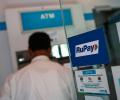
RuPay National Common Mobility Card's offline wallet can be used to make ticket payments in transit, including in metros, cabs, etc, enabling automatic, quick, cashless payments.
The decision to procure the fleet was taken at a meeting of the Cabinet Committee on Security (CCS) chaired by Prime Minister Narendra Modi, Defence Minister Rajnath Singh said.
Indian economists hope national elections produce a stable government committed to strong growth, privatisation, infrastructure investment and outsourcing.\n\n\n\n
At present, the EPFO is mandated to invest 20-45 per cent of its incremental funds - of around Rs 1.5 trillion - in debt-related instruments.

The Chief Justice of India, Justice N V Ramana Saturday said the Legislature needs to revisit laws and reform them to suit the needs of time and people so that they match 'practical realities'.

The heavy industries ministry has asked US-based electric car major Tesla to first start manufacturing its iconic electric vehicles in India before any tax concessions can be considered, government sources said. They said that the government is not giving such concessions to any auto firm and giving duty benefits to Tesla will not send a good signal to other companies that have invested billions of dollars in India. Tesla has demanded reduction in import duties on electric vehicles (EVs) in India.

This upgrade will allow air operations by military and civil aircraft even in poor visibility and adverse weather conditions.
India needs to reform its financial market to expand the sources and availability of credit to meet the rising demand from the private sector, according to global rating agency Moody's Investors Service.

It boosts confidence to investors sitting on the fence.

'This is happening regardless of the Budget.'

Ukrainian officials said Russian forces struck near the western Ukrainian city of Lviv, without providing extensive details.
No prior approvals required for setting up off site ATMs will enable banks speed up their franchise expansion.

Asserting that the self reliant India programme will help revive the global economy, Prime Minister Narendra Modi on Thursday told global business community that his government aims to transform the country through access, inclusion and empowerment while also ensuring complete data security. Addressing the World Economic Forum's online Davos Agenda Summit, where he also interacted with global business leaders, Modi also said India offers a predictable and friendly environment from tax regime to FDI norms. He said Aatmanirbhar Bharat movement is committed to global good and global supply chain while the country's digital profile has been completely transformed.

Covering-up of pending short positions on expiry of the July derivatives contracts and a strengthening rupee propped up the markets at high levels

'Due to the huge unemployment among displaced Adivasis they undertake any job that comes their way even if it means working and living in hazardous conditions.' 'The situation is such that out of every five tribals who migrate in search of employment only three come back alive.'
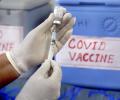
Maintaining a rapid pace of the vaccination drive and quickly bridging healthcare infrastructure gaps across both urban and rural areas would emerge as the most sustainable stimulus for durable recovery of the Indian economy, says a report by the department of economic affairs.

The 30-share Sensex, after opening on a strong footing, continued its upward march to hit an all-time high of 35,827.70. The NSE Nifty also hit a record intra-day high of 10,975.10, before finishing at 10,966.20, up 71.50 points.

20 defence ministry reforms 'is a reflection of the resolve of the government to make the defence sector stronger and more efficient.'

Engineering giant Larsen & Toubro (L&T) is looking to divest its exposure to road and power concessions and incubate digital and e-commerce businesses as part of its new five-year plan ending 2025-26 (FY26). The base year for the plan is 2020-21 (FY21). The blueprint, called Lakshya 2026, is intended to help the company exit sub-scale businesses, concentrate on high-technology (tech) manufacturing, construction and green energy projects, and increase its share from information technology (IT) and digital services. The lending operations of the financial services business, meanwhile, will be reorganised, with focus on retail lending.
World's top chip maker Intel and the government on Thursday agreed to jointly develop computing platforms to address issues of affordability, local infrastructure and community usage models to enable and empower rural citizens to participate in infor
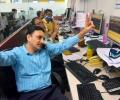
Titan was the top gainer in the Sensex pack, rising over 3 per cent, followed by M&M, Reliance Industries, Axis Bank, TCS, Maruti and Infosys. NSE Nifty surged 122.10 points to 15,885.15.

Under Pradhan Mantri Kisan Samman Nidhi (PM-KISAN) scheme, the Centre provides an annual financial benefit of Rs 6,000 to eligible beneficiary farmers in three equal four-monthly installments of Rs 2,000 each.

FIFA presidential hopeful Luis Figo will travel to the Caribbean this week hoping to tempt voters in the CONCACAF region with a plan to distribute more funds, $2.5 billion (1.7 billion pounds) over four years, to national associations.

The Rail Land Development Authority has invited online bids from private players to redevelop the station into an integrated commercial, retail, and hospitality hub.
 © 2026 Rediff.com - Advertise with us - Disclaimer - Privacy Policy - Sitemap - Feedback - About us - Terms of use - Grievances